
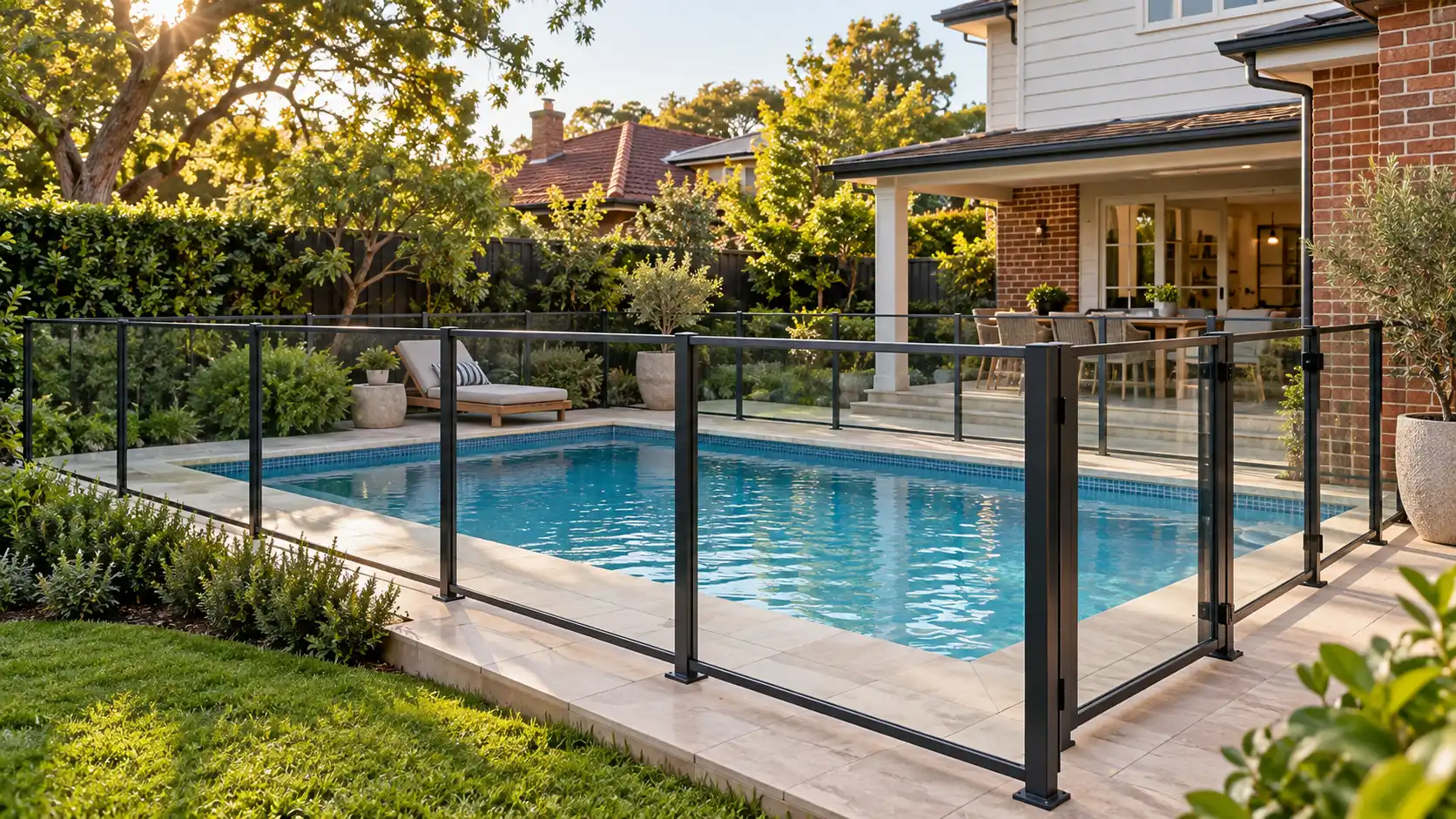
Glass pool fencing can preserve the outlook across a backyard while providing a clearly defined boundary around the water. For many Sydney homes it offers a useful middle ground: more visual openness than an opaque fence, with a framed or semi-framed structure that can adapt to varied sites and budgets. The result can feel crisp and contemporary, but it can also sit quietly beside older homes and established gardens.
Choosing a glass fence involves more than deciding that you like the transparent look. The frame style, gate location, panel layout, paving and maintenance routine all shape the finished project. This guide looks at those decisions in practical terms so you can compare options and have a more productive conversation during the site measure.
Understanding framed and semi-framed glass
“Glass pool fencing” often refers to systems where glass panels are supported by posts, channels or a combination of framing components. Some include a continuous top rail, while others use posts between panels and leave the top edge open. These systems are visually lighter than solid fencing but show more structure than a fully frameless spigot-mounted fence.
That visible structure is not necessarily a compromise. Slim posts can create an orderly rhythm around the pool and connect with dark window frames, pergolas or balustrades elsewhere on the home. The frame can also make it easier to respond to changes in level or to create a consistent line on a site that is not perfectly flat.
Different systems use different panel sizes, fixing details and gate arrangements. Ask what is being proposed rather than relying on broad labels. A sample post or a photograph of a comparable completed installation can reveal much more than the word “framed” on a quotation.
Where glass works particularly well
Glass is valuable when people need to see the pool from another part of the property. A clear line from the kitchen, family room or covered outdoor area allows the pool to remain connected to everyday life. The fence does not replace active supervision, but it avoids creating a visual wall across the yard.
It also suits compact gardens. An opaque barrier can make the space inside and outside the fence feel like two small rooms. Glass allows light, planting and paving to continue visually through the boundary. A narrow pool courtyard often feels more generous when the fence does not stop the eye.
On larger properties, framed glass can define the immediate pool zone without concealing a distant view. The darker posts become fine vertical markers while the landscape remains visible between them. This is useful on sloping blocks, near bushland, or where the garden beyond the pool contributes to the outlook.
Planning the fence as part of the landscape
The cleanest projects consider the fence line alongside paving, planting and movement through the yard. Begin by mapping the route people take from the house to the pool. The gate should meet that route naturally. A misplaced entry can lead to awkward circulation, furniture being pushed into unsuitable positions or constant detours around garden beds.
Look closely at corners. A turn in the fence creates extra posts and shorter panels, so it becomes a stronger visual point. Sometimes aligning a corner with a change in paving or a wall makes it feel intentional. Moving it a small distance can also keep the most important view from the house centred within a glass panel rather than interrupted by a post.
Planting needs room to grow without crowding the barrier. A small shrub can become a large obstruction in a few seasons. Select plants and set garden edges with their mature size in mind. Keep moveable pots, furniture and storage away from the gate and from areas that need to remain clear under the property’s applicable pool barrier requirements.
Posts, rails and colour choices
Powder-coated black is popular because it recedes against foliage and connects with contemporary doors and windows. Charcoal, white and other colours may suit particular homes, but colour should be considered in the context of the whole yard. A white frame can feel light against pale paving yet become more prominent against a dark garden.
A top rail gives the fence a strong horizontal line. This can be useful where the architecture already has pronounced eaves, deck edges or wall caps. An open-top semi-framed system feels lighter and puts more emphasis on the individual panels. Neither approach is automatically better; the decision depends on the system, the site and the look you want.
Finish quality matters because the eye follows a repeated frame. Posts should appear plumb, spacing should be consistent and rails should meet neatly at corners. Gate frames and latches should feel like part of the same family. These details are easier to resolve when the layout is measured carefully before components are ordered.
The glass itself
Pool fencing panels are made for a demanding outdoor use. The glass specification, dimensions and processing need to suit the selected system. Edges and cut-outs are prepared before toughening, so measurements must be correct before manufacture. This is one reason installers pay close attention to completed paving and finished levels.
Larger panels create fewer vertical breaks, but they are heavier and harder to carry through a restricted property. A narrow side path, steps, tight corners or an upper-level pool can place practical limits on panel size. A thoughtful layout balances clear views with safe handling and realistic installation access.
Visible distortion and reflections are normal characteristics of glass, especially across long views or at certain angles. Water, sky and surrounding windows will all appear in the surface. Good design uses those reflections as part of the landscape rather than expecting the fence to be literally invisible in every light.
Gate placement and daily use
The gate should be obvious, comfortable to approach and free to operate. It needs enough space for the leaf to move without hitting a wall, step, post or furniture. The hinge and latch arrangement also needs the correct support. A gate placed at the very edge of a difficult level change may require more preparation than one moved slightly along the run.
Think about the view through the closed gate. Framing and hardware are concentrated here, so placing the gate directly in front of the most important sightline may not be ideal. At the same time, hiding it in a remote corner can make daily access inconvenient. The right position usually balances appearance with the natural path from the house.
After installation, the gate should be checked as part of routine home maintenance. Movement in paving, heavy use or an accidental impact can affect alignment. If the gate no longer closes and latches as intended, organise an adjustment promptly rather than holding it open, adding makeshift hardware or assuming it will correct itself.
Working with existing paving and levels
A fence is only as orderly as the line below it. Uneven coping, sloping paving and stepped garden edges can all change panel heights and post positions. The installer will assess whether the fence should follow the fall, step at controlled points or use another layout. Seeing those options on site is far easier than trying to resolve them from a plan alone.
Existing paving should be inspected for suitability. A tile or paver may conceal a substrate that was not designed for concentrated fence loads. Core holes, base plates or other fixings need adequate material beneath them. If strengthening or local concrete work is needed, it is better to identify that before the installation day.
For a new landscape, coordinate trades early. Provide the intended fence line to the builder or landscaper and confirm finished levels before fabrication. This can prevent drains, decorative borders, expansion joints or services from appearing exactly where a post or gate support needs to go.
Cleaning glass without making it a chore
Glass shows spray, fingerprints and dust, but a simple routine keeps the work manageable. Rinse loose dirt before wiping so grit is not dragged across the surface. Use clean, non-abrasive tools and a product suited to the glass and surrounding materials. Drying the panel helps reduce spots, particularly in areas with mineral-rich water.
Pool equipment and irrigation can make a large difference. Redirect sprinklers that constantly wet the fence and check that pool water is not repeatedly splashed onto one section. The less residue that reaches the panels, the less often they need a full clean.
Frames and fittings also need care. Wash powder-coated components gently and rinse metal hardware with fresh water, especially in coastal areas. Avoid strong chemicals or abrasive pads. The component manufacturer’s maintenance advice should guide the products and frequency used on your particular system.
Comparing glass with other materials
Compared with aluminium pickets, glass preserves more of the view and blocks less visual space. It normally costs more and requires more frequent cleaning. Aluminium can be the better choice where privacy, a long boundary run, a sloping site or a tighter budget is the main concern.
Compared with fully frameless glass, a framed system has more visible structure but can provide a different cost and installation profile. Some homeowners prefer the strong outline because it relates to the home. Others want the hardware reduced as far as possible. Looking at completed examples in a similar setting is more informative than comparing isolated product samples.
Mixed solutions are also possible. A key sightline may use glass while a less visible boundary uses aluminium or another suitable material. The transitions need careful detailing, but a combination can direct the budget to the area where transparency has the greatest effect.
Questions to ask before accepting a quote
- Which glass system and frame profile are included?
- How will the fence respond to changes in level?
- What preparation is assumed beneath the paving?
- Where will the gate sit, and which way will it operate?
- Are removal, disposal, special panels and final adjustment included?
- What maintenance is recommended for the finish and hardware?
Pool barrier requirements depend on the site and approval context. Your contractor can design and install the proposed work, while the relevant council or a suitably qualified certifier can confirm the requirements that apply to the property. Raise compliance questions before fabrication so they can inform the layout.
Making the final decision
A successful glass fence should look considered from the important viewpoints and work naturally every day. The panels, frames and gate need to suit the structure below them, and the cleaning expectations need to suit the household. When those practical points are resolved, the visual openness becomes a lasting advantage rather than the only reason for the choice.
Explore our glass pool fencing service or arrange an on-site consultation. Pool Fencing Sydney can measure the proposed line, review levels and access, compare framed and frameless approaches, and prepare a clear recommendation for your home.